There's a particular feeling about walking into your local pub. The warmth hits you first — not just the temperature, but the noise, the familiar faces, the sense that this place exists for you. You don't need an agenda. You're not there to accomplish something. You're just there.
Millions of people lost regular access to that feeling. Remote work, relocated friends, city moves, life changes — the local became harder to reach. And for a while, everyone just… accepted that "grabbing a drink with friends" meant a slightly awkward Zoom call where someone always had their camera off.
Virtual pubs are changing that. They're not a perfect substitute — nothing is. But they're better than anyone expected, and a lot of people have discovered this only recently.
What Actually Makes a Pub Feel Like a Pub?
Before you can recreate it online, it helps to understand what you're actually recreating. The pub experience isn't really about the beer. It's about a persistent, neutral social space — somewhere you can drop in without an agenda, find familiar people, and leave when you want.
The key ingredients are:
- Ambient social noise — other people are around, background conversation, the sense that something is always happening
- No pressure to perform — unlike a dinner party, you don't have to entertain. Silences are fine. Side conversations happen.
- Persistence — the pub is still there whether you go or not. It doesn't exist only when you schedule it.
- Face-to-face video — reading body language, seeing reactions, being genuinely present
A grid of faces on Zoom satisfies the last point weakly, misses the others entirely. That's why it never really felt like "going out".
The Virtual Pub Difference
A proper virtual pub isn't a video call with a pub background. It's a purpose-built social space where the venue itself shapes the experience.
The best ones give you:
- A persistent venue people can drop into — not a meeting link that only works if everyone shows up at once
- Multiple separate "tables" or rooms, so different groups can have their own conversations
- Video and audio built into the space, not bolted on
- Themed environments that shift your mental state from "work call" to "this is somewhere"
Who Uses Virtual Pubs, and Why?
The people who've adopted virtual pubs most enthusiastically are:
- Remote teams that want a Friday afternoon wind-down that isn't a forced "fun" meeting
- Friend groups scattered across cities or countries who used to have a local together
- Long-distance relationships where couples want to hang out without it needing to be a "date night" every single time
- Communities and guilds who want casual meeting space that isn't their work Slack
What they have in common: they want presence without pressure, and they want to feel like they're somewhere, not just connected.
What to Look For in a Virtual Pub
Not all virtual pubs are equal. When you're picking one for your regular hangout, look for:
- No download required — if someone has to install software, half your friends won't bother
- Multiple rooms or tables — important when groups get bigger or sub-conversations want to split off
- Themed atmosphere — makes a real difference to the feeling. Plain video chat with a pub background image isn't the same as a dedicated pub environment
- Free to use — ideally no freemium tier that gates the actual useful features
- Low friction joining — your friends should be in the room in under 30 seconds
ChiffTown's Chiff Inn: The Virtual Pub That Feels Right
ChiffTown built The Chiff Inn as one of the venues in a larger virtual town — and the pub experience here stands out because it was designed with the right priorities.
You walk in (metaphorically — via a browser tab), see the active tables, and join or create your own. The video chat starts immediately. There's no sign-up wall, no app to download. Anyone with the link is in within 10 seconds.
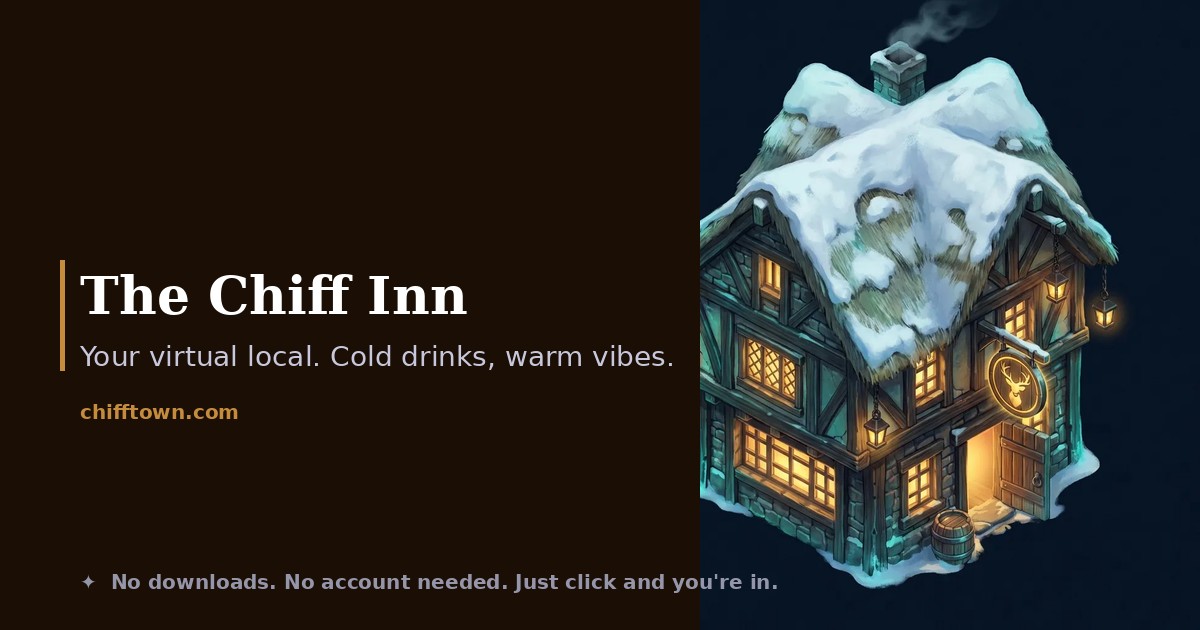
The venue itself looks and feels like a proper warm pub — amber lighting, wood tones, the right atmosphere. And because it's part of a full virtual town, there's always the option to wander into the nightclub next door, catch a film at the cinema, or end the night somewhere quieter if the mood shifts.
Making It a Regular Thing
The virtual pub works best when it becomes a regular habit, not a one-off experiment. Here's how to make it stick:
- Set a time — "Friday at 6pm, Chiff Inn" is much more sustainable than "we should do this sometime"
- Keep it optional — the pub's best when no one feels obligated to perform. Drop in, drop out.
- Let it be boring sometimes — the best pub sessions aren't the ones where someone planned entertainment. They're the ones where nothing in particular happened.
- Use it for existing friend groups first — trying to build community in a virtual pub cold is hard. Using it with people who already know each other is easy.
The virtual pub won't feel like your old local on the first try. It might feel a bit self-conscious, a bit "is this weird?". Give it three or four sessions. By then, it'll just be the thing you do on Friday evenings. And you'll wonder why you didn't start sooner.